
Nov 17, 2026
Read in: English (United Kingdom)
What 'Built by' Credits Reveal About Agency Client Turnover
Agency credit links reveal client turnover patterns months before public announcements. Research shows 43% of B2B churn occurs within the first 90 days of a contract. Teams that monitor footer badge removals identify service gaps and pitch replacement solutions to brands that recently ended relationships with their previous agency partners.

Website footers contain clear public evidence about supplier relationships that competitors routinely miss. You can spot client departures and new account wins months before agencies publish formal case studies. Research confirms that 43% of business-to-business churn happens within the opening 90 days of a supplier contract[1]. Teams that monitor public badges identify active service gaps and pitch replacement solutions with high confidence. Concrete web data separates real agency retention from marketing claims.
Technographic Data and Agency Footprint Analysis
Technographic indicators and digital footprint analysis allow research teams to verify agency credit links across public websites. Many commercial teams attempt to evaluate return software implementation status across ecommerce clients because public markup reveals production code. Inspecting public source code reveals content management tags and custom scripts that verify whether an agency actively maintains a client domain or abandoned it after launch.
Scraping public records provides clear technical context when analysts combine code signatures with corporate filings. Statutory data confirms legal entity status, while digital fingerprinting confirms whether an external supplier manages the live website infrastructure. Agencies frequently leave legacy badges online for months after contract termination, which causes false partnership assumptions without active technographic checks. Careful manual auditing ensures that teams never rely on outdated web credentials during outreach campaigns.
Role of Footer Credits in Agency Partnerships
Agency credit links establish public social proof and direct referral traffic from completed client websites. Design agencies negotiate mandatory footer credits in standard client contracts to showcase technical execution to prospective buyers. Studies indicate that new client acquisition costs agencies between 5 and 25 times more than retaining existing accounts[3].
Footer badges serve as passive portfolio pieces that remain visible across millions of consumer impressions. Many growing brands tolerate these external supplier links during launch phases to offset initial web development fees. However, maturing companies often remove supplier backlinks during platform rebrandings or when hiring in-house technical teams. Strategic partners monitor these transitions to identify newly available accounts.
Identifying Gaps Through Footer Badges
Monitoring changes in footer badges exposes underlying service gaps and agency specialism transitions. A client replacing a general agency credit with a specialised ecommerce partner badge signals operational dissatisfaction. Digital auditors track these modifications daily.
Observing AI content saturation helps analysts evaluate when clients split digital responsibilities among competing suppliers. Brands often retain original development agencies for maintenance while hiring independent search teams for content. Specialized vendors capture these emerging opportunities.
Shifts in external credits highlight service delivery friction before public contract terminations occur. In contrast, stable agency credits across multi-year cycles signal high client alignment and steady account health. Commercial analysts evaluate these patterns closely.
Detecting Churn Through Badge Disappearance
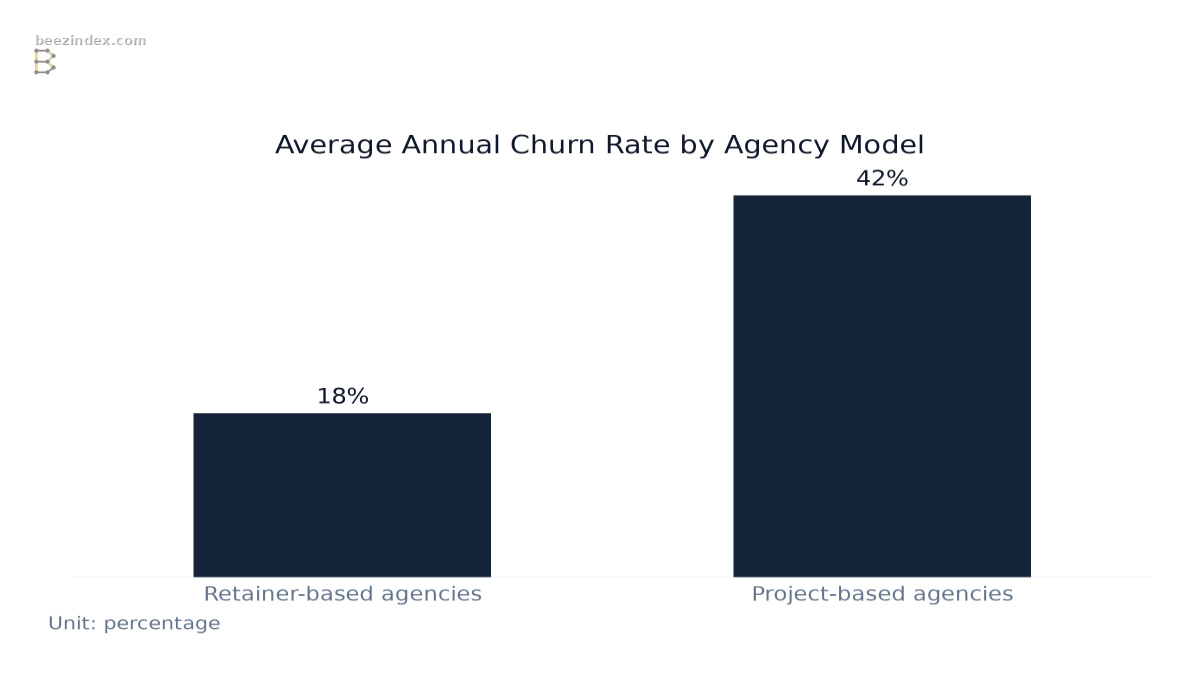
Sudden badge removal provides strong client turnover signals that indicate supplier contract cancellations. The disappearance of a footer link usually marks the completion of a website migration or a vendor transition. Retainer-based agencies experience an average annual churn rate of 18%. Project-based agencies experience an average annual churn rate of 42%[2].
Agency teams that track code modifications capture account displacements long before trade publications announce client reviews. Project work carries high structural turnover because client relationships conclude immediately upon software deployment. As a result, commercial research teams monitor badge removals to identify accounts that need ongoing strategic retainers. Proactive outreach secures vulnerable accounts before competitors intervene.
Average Annual Churn Rate by Agency Model
Observable Web Intelligence for Partnership Research
Observable web intelligence combines footer link tracking with domain metadata to deliver verified partnership research. Researchers analyze script changes and domain header updates to confirm genuine vendor relationships without guessing. Technical verification eliminates guesswork entirely.
Teams avoid optimizing uk tech budgets when auditing digital performance because isolated page metrics do not explain supplier tenure. Looking beyond raw performance numbers helps researchers identify authentic client engagement levels. Thorough inspections reveal true operational relationships.
Structured data layers track website modifications across thousands of corporate domains over continuous time horizons. Comparing visible footer links against third-party analytics libraries produces verified intelligence on vendor market share. Comprehensive databases map industry shifts efficiently.
Benchmarking Retention by Industry Sector
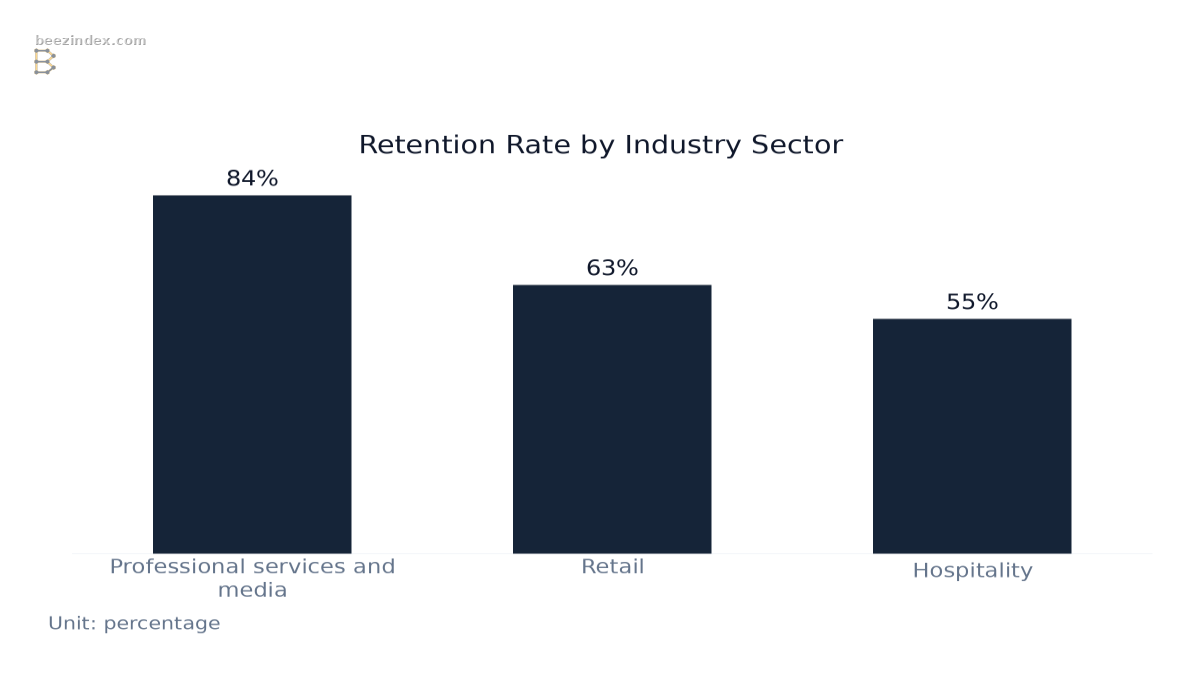
Client retention varies substantially across different commercial sectors due to operational business pressures. Professional services and media lead with 84% retention, while hospitality and retail see lower rates of 55% and 63%. Sector dynamics heavily influence contract stability.
Consumer-facing sectors experience rapid turnover because marketing directors face immediate commercial sales pressures. Retail brands frequently rotate creative agencies every twelve months to test fresh consumer acquisition campaigns. Fast-paced markets demand constant agency evaluation.
Professional service firms maintain stable supplier relationships because complex corporate operations discourage frequent digital migrations. Understanding sector benchmarks helps partnership managers evaluate whether badge disappearance reflects normal sector turnover or specific supplier failure. Contextual analysis prevents strategic missteps.
Retention Rate by Industry Sector
Compliance Rules for Monitoring Web Credits
Data compliance frameworks require organizations to respect automated crawl limits when collecting public website signals. Regulatory authorities like the Information Commissioner's Office warn against data-matching tactics that append public contact details to internal databases. Analysts avoid rate limit errors by managing companies house api limits properly and observing website robots directives during automated collection.
Scraping public business indicators remains fully compliant under UK law when processes collect corporate technographic signals instead of personal information. The Data Protection Act 2018 protects individual privacy rights while allowing legitimate monitoring of corporate digital infrastructure. Partnership researchers maintain compliance by analyzing domain technologies without harvesting personal staff email addresses. Legal adherence ensures long-term operational success.
Using BeezIndex to Track Agency Portfolios
BeezIndex collects structured public company signals to give sales teams verified corporate intelligence across Britain. The system tracks domain technologies, corporate filing histories, and live website modifications to detect significant market changes. Users run free searches to explore company data and upgrade to paid plans for continuous portfolio monitoring. Automated insights streamline prospecting workflows.
Automated alerts track website changes to highlight whenever target accounts remove agency supplier links. This automated intelligence allows business development teams to pitch services precisely when competitors lose account control. Combining technographic observations with official Companies House filings ensures high confidence throughout partnership prospecting. Data-driven outreach maximizes conversion rates.
What to Remember
Footer credits and technographic code signatures provide verifiable evidence of agency account retention and client turnover. Retainer-based agencies maintain an 18% churn rate, while project-based suppliers experience 42% annual account loss[2]. Tracking these digital breadcrumbs gives business development teams early warnings about client turnover months before public announcements.
Modern partnership teams must combine public web signals with structured statutory records to build accurate prospect pipelines. Review your target agency accounts today by scanning client footers for missing links and altered developer tags. Comprehensive digital audits uncover hidden revenue opportunities across competitive markets. Strategic planning depends on verified web intelligence.
Frequently Asked Questions
How quickly do clients remove agency footer credits after firing an agency?
Most brands remove footer links during their next major deployment cycle, which typically takes between 30 and 90 days. Some clients leave legacy badges online for over 12 months if they lack internal technical staff. Automated crawlers identify these removals by checking the root HTML code weekly.
Can agency credits remain online after a contract ends?
Yes, many websites retain original credits until a new supplier conducts a complete platform redesign. Research teams verify live relationships by cross-referencing footer badges with recent code commits and analytics tags. Signal decay occurs when teams rely exclusively on visual footer text without technical verification.
Is tracking footer links compliant with UK data privacy regulations?
Monitoring public corporate websites complies fully with UK GDPR and PECR when teams collect non-personal domain data. The Information Commissioner's Office permits corporate technographic tracking for legitimate market research purposes. However, teams must not harvest personal email addresses or bypass published website rate limits.
What is the primary cause of early agency client churn?
Research indicates that 43% of B2B client churn occurs during the first 90 days due to poor strategic alignment[1]. Onboarding delays exceeding 48 hours also correlate directly with higher account cancellation rates. Price disputes rank sixth among common reasons for client departures.
Start a free search on BeezIndex to discover verified company signals, then upgrade your plan to access advanced tracking and portfolio intelligence.
Track Agency Client Portfolios Today