
Nov 19, 2026
The Subdomain That Hides a UK Firm's Real Commerce Stack
Standard web scanners often report incorrect commerce platforms because many UK firms host their online shops on separate subdomains. This guide explains how to map public certificate records and DNS data to find hidden infrastructure. Use these steps to verify the real commerce stack and improve your account intelligence today.

Standard scanners miss critical retail infrastructure because many companies host their core shopping carts on separate network endpoints. Research teams often record WordPress on the main address while a merchant runs high-volume sales through Shopify Plus or Magento elsewhere. Flawed technographic profiles derail sales campaigns, distort market share analysis, and weaken competitive research across British industries. You can expose true digital footprints by inspecting public network records and mapping checkout environments directly.
Subdomain Discovery in Modern Digital Commerce
Modern digital architecture lets enterprises separate corporate branding from transactional storefronts to optimize server performance, simplify maintenance, and maintain strong security boundaries. A company often hosts its main editorial site on a content management tool while routing actual transactions through dedicated hidden shop subdomains. Marketing departments run lightweight blogs on root domains, but their engineering counterparts place the primary transactional catalog on an external host because decoupled systems reduce load on core company pages.
Engineering teams frequently divide infrastructure this way to reduce security risks and maintain payment compliance without rebuilding their existing content portals. Evaluating B2B data platforms requires examining these split configurations because root-domain checks report incomplete profiles when shops operate on separate prefixes. Commercial researchers who inspect only the primary host miss the presence of enterprise systems, creating gaps in buyer classification and competitive benchmarking.
Why Root Domain Checks Miss Systems
Automated scanners evaluate only the root address during surface checks. Simple web scrapers fetch the index file, read headers, and terminate the session before following outbound navigation links. This brief crawl records the homepage CMS while overlooking the actual commerce stack audit required for true qualification.
Corporate portals regularly mask external transaction engines by linking out to independent hosts, allowing marketing teams to operate freely. Scanners without deep link extraction log the publishing software as the sole commerce system, generating false technical records.
Certificate authorities log many domain assets in public records, creating an observable trail for security analysts and research teams.[1] Teams miss valuable technical evidence when they skip these public registries during company audits.
How to Audit Hidden Commerce Stacks
- Map Public Certificate Records
Query Certificate Transparency logs using automated tools or web interfaces to discover every registered hostname. Inspect historical certificate entries to find older storefront names that still handle traffic. - Resolve Active Network Names
Filter the discovered list by sending lightweight DNS queries to confirm which hosts currently resolve to live IP addresses. Discard dangling records to avoid chasing inactive development projects. - Isolate Commerce Keyword Prefixes
Scan the resolved addresses for standard terms like store, shop, checkout, portal, or cart. Filter these targeted hostnames into a separate queue for immediate platform fingerprinting. - Extract Checkout HTTP Headers
Send GET requests to the identified shop URLs and read server response headers. Identify platform-specific markers, cookie prefixes, and asset paths that reveal underlying software. - Inspect Client Side Scripts
Open page source code to identify platform JavaScript libraries, cart APIs, and tracking scripts. Confirm whether the backend relies on hosted SaaS software or custom self-hosted frameworks. - Verify Payment Processing Gateways
Navigate to the payment stage to verify active merchant gateways like Stripe or enterprise acquirers. Document the complete technology chain from host to checkout gateway to complete the audit.
Platform Footprint Analysis for Market Researchers
Market analysts need verified technical records to measure platform adoption, assess vendor market share, and identify real commercial opportunities across British firms. Technographic data reveals whether a merchant runs modern SaaS infrastructure or legacy self-hosted software, informing outreach strategies and product positioning. Teams must analyze online review platforms alongside technical audits to confirm whether operational software delivers genuine buyer satisfaction or creates checkout friction.
Enterprise brands often manage multiple hostnames across different trading divisions to support wholesale, direct consumer sales, and international orders. A single UK firm domains profile might contain an internal trade portal alongside a high-volume consumer checkout on another host. Researchers who catalog every operational subdomain produce accurate account intelligence and avoid misclassifying major commercial operations.
Distribution of Major UK Commerce Engines
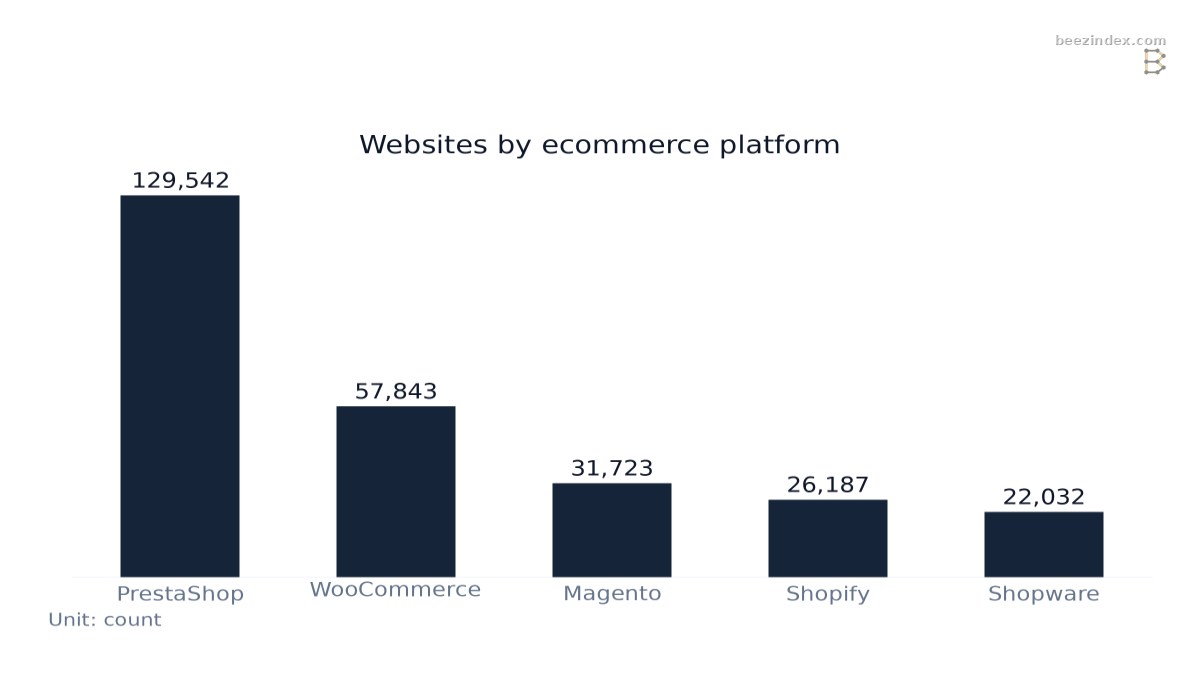
Online retailers across Britain deploy varied software stacks depending on operational scale, internal technical resources, and product catalog complexity. While specific market share figures fluctuate, major platforms like PrestaShop, WooCommerce, Magento, Shopify, and Shopware represent significant portions of the active digital landscape. These counts reflect active websites detected across independent digital properties, illustrating substantial platform diversity in the current marketplace.
Large retail brands often adopt enterprise configurations such as Shopify Plus when sales volumes scale significantly. Smaller businesses frequently install WooCommerce because the core software operates without upfront licensing fees on self-managed hosting environments. Auditing specific hostnames confirms whether a company runs standard store instances or custom enterprise software.
Websites by ecommerce platform
Subdomain Discovery Techniques for Prospecting Teams
Beyond simple observation, teams can employ specific methodologies to map out the full digital footprint of a target organization.
Sales teams locate qualified accounts faster when they track technical signals beyond the root domain. Passive intelligence gathering uncovers hidden shop subdomains without triggering web security alerts or aggressive rate limits on prospect servers.[2]
Public certificate registries allow ethical researchers to monitor infrastructure updates when companies publish new web properties.[1] Analysts inspect these records to spot new commercial initiatives. Spotting signs of turnover becomes simpler when agencies replace old shop subdomains with modern headless architectures.
Targeted search operators also reveal forgotten or hidden retail paths across company networks. Running site queries for specific subdomains uncovers development stores, beta shops, and international endpoints that standard site scrapers skip during routine sweeps.
Auditing the Verified Commerce Stack
A rigorous audit requires inspecting observable web intelligence directly from checkout pages rather than relying on homepage metadata. Analysts examine client-side code, script dependencies, and API endpoints to verify the active transaction engine. The process uncovers custom integrations, third-party payment gateways, and backend shipping plugins that power daily retail operations.
BeezIndex provides verified company-to-website intelligence by mapping technical assets across complete domain networks to ensure high confidence. Users start with a free search to explore core company data before choosing advanced monitoring tools to track software changes over time. Examining connected hostnames ensures commercial teams understand your market and evaluate buyer capabilities accurately.
Compliance Rules in Technical Stack Audits
Data intelligence teams must collect technographic signals responsibly while respecting network infrastructure and legal boundaries across Britain. Passive discovery methods can help research teams review public records without disrupting business services or breaching crawler rate limits. Modern teams combine these structural checks with deploying agentic ai tools to synthesize observable software footprints into actionable accounts without manual friction.
Financial security standards require strict controls around checkout environments and payment data handling. Payment providers often enforce PCI DSS Level 1 compliance and handle 3D Secure verification to satisfy European regulations. Researchers evaluate these public payment flows to verify regulatory readiness without handling sensitive cardholder details.
What to Remember
Root domains tell only half the story when UK companies divide marketing content and transactional commerce across separate infrastructure. Passive scanning through public certificate logs and DNS validation uncovers genuine commerce platforms that basic homepage checks overlook. Accurate data collection ensures commercial teams evaluate genuine technical capability rather than marketing surface layers.
Begin your next tech stack audit by compiling complete subdomain lists from public certificate transparency logs before drawing conclusions about platform adoption. Verify active checkout endpoints directly to correct your customer database and build high-confidence prospect profiles.
Frequently Asked Questions
Why do companies separate their main website from their online shop?
Companies separate these functions to isolate high-traffic marketing blogs from critical checkout operations and optimize server performance. This decoupled approach also reduces security risks by keeping payment gateways on dedicated, hardened hosting environments.
What is the fastest passive method to discover hidden shop subdomains?
Querying Certificate Transparency logs provides a passive discovery method without scanning the target server directly. These public logs reveal many SSL certificates issued for specific hostnames like shop or checkout.
Can automated tools detect headless e-commerce architectures on subdomains?
Yes, automated tools identify headless commerce by monitoring network calls and API requests made to backend platforms. Inspecting client-side JavaScript reveals connections to hosted commerce engines even when the storefront uses custom frontend frameworks.
Are passive subdomain audits legal under UK data regulations?
Passive subdomain auditing is generally conducted by querying public DNS records and Certificate Transparency logs rather than unauthorized systems. Researchers should respect standard rate limits and public access terms when querying live web endpoints.
How does finding subdomains improve sales prospect qualification?
Locating hidden shop subdomains reveals the true scale and software budget of a commercial account. Sales representatives avoid pitching basic web solutions to enterprise businesses that run sophisticated commerce engines on secondary hostnames.
Start a free search today to uncover complete platform footprints, verify hidden subdomains, and monitor UK company technology changes.
Find Hidden Tech Stacks with BeezIndexReferences
- Subdomain Discovery Using Certificate Transparency Logs
- How To Discover Hidden Subdomains As An Ethical Hacker
- Find Subdomain of any Website. Subdomain Finder Tool!
- How to protect your site from subdomain takeover - Outpost24
- The Ultimate Guide to Subdomain Enumeration: Techniques, Tools, and Best Practices | by MR Gh0st [ 0xff ] | Medium