
Sep 17, 2026
Read in: English (United Kingdom)
How to Find UK Companies Using WordPress
Over 98,000 businesses across the United Kingdom maintain production sites on WordPress. Sales teams identify these prospects by filtering for specific technical footprints, geographic locations, and active hiring requisitions. This approach replaces guesswork with verified data to help agencies and security firms connect with high-value commercial accounts in 2026.

Pinpointing the right technological stack transforms cold outreach into a precision exercise for B2B growth teams. You need verified company-to-website intelligence that surfaces active installations across Britain with clear operational evidence. Over 98,000 businesses across the United Kingdom maintain production sites on this open-source architecture right now. Observable web intelligence connects registered entities directly to detectable software footprints, active recruitment, and commercial sectors. Grounded technical data replaces guesswork so you identify genuine commercial opportunities before your competitors reach them.
Reading WordPress Footprints from Public Web Signals
Specialist crawlers detect companies using WordPress UK by inspecting public document markup, standard script paths, and structural responses that web servers broadcast during standard page requests. Production installations routinely expose asset paths containing wp-content or wp-includes, generator tags, and standard REST API endpoints at wp-json. Teams track specific ecommerce technology across multiple digital storefronts because WooCommerce stores expose specific shopping cart fragments and AJAX endpoints that confirm commercial functionality.[1]
Technical footprint analysis reveals active plugin configurations and style references connected to what is observable online without accessing administrative panels. Enterprise security headers or asset minification tools mask direct meta generator tags, but characteristic file directories and theme stylesheets remain publicly visible. Outreach teams eliminate guessing because automated scanners verify these digital fingerprints and prevent calls to businesses running proprietary hosted builders.
Why WordPress Companies Are a High-Value Segment for UK Outreach
UK companies using WordPress represent a prime commercial market for specialized agencies, cloud hosting vendors, security firms, and enterprise plugin providers. WordPress adoption across the United Kingdom increases alongside organizational scale, reaching 43.3% among firms employing more than 50 staff members. Broad standard industrial classification codes fail because they group web-enabled enterprises with offline operations, while verified technical discovery confirms operational digital infrastructure.[2]
Targeted software discovery delivers high confidence when pitching technical improvements, infrastructure migrations, and maintenance agreements to active corporate buyers. Understanding your market through measurable website attributes allows technical sales teams to tailor pitches around observed vulnerabilities, legacy themes, or outdated plugin stacks. Service providers convert conversations faster because they address demonstrable site requirements rather than generic business services.
Filter Dimensions for WordPress Sourcing
| Filter Dimension | Observable Signal | Best Use Case | Freshness Cycle |
|---|---|---|---|
| Geographic Region | UK server IP and address | Regional sales territory allocation | Weekly verification |
| Industry Sector | On-page metadata and registrations | Niche agency prospecting campaigns | Monthly refresh |
| Active Recruitment | Published ATS job requisitions | Timing expansion services outreach | 45 day window |
| eCommerce Plugins | WooCommerce scripts and carts | Merchant gateway replacement pitches | Bi-weekly crawls |
| Security Posture | SSL renewal and application firewalls | Cybersecurity compliance audit sales | Daily monitoring |
| Theme Architecture | Full Site Editing block structures | Frontend modernization project proposals | Monthly audit |
Validating a UK WordPress Company List with Freshness and Confidence
Beyond basic discovery, the accuracy of your prospect list depends on how you handle the volatility of the digital landscape.
Reliable technical prospecting prioritises matching confidence by confirming live site infrastructure across multiple data points before commercial teams initiate direct conversations. Technographic platforms generate confidence scores ranging from 0% to 100% based on the volume and quality of visible platform indicators. Analysts locate uk businesses software to verify primary installations and avoid chasing dead domains or static landing pages.
Scanners measure evidence and freshness indicators by calculating crawl dates, header timestamps, and functional server responses. Stale technical data degrades prospecting efficiency because businesses migrate platforms regularly across the web. Outdated records cause agencies to pitch redundant services to firms that moved away months ago.
High verification thresholds safeguard outbound domain reputation and keep conversion rates predictable during outbound campaigns. Organizations must enforce strict verification rules to comply with PECR standards and substantiate legitimate interest under UK GDPR. Verified operational data protects sender reputation and eliminates misdirected technical outreach across prospective client lists.[1]
From Broad UK Search to Verified WordPress Shortlist
- Define Technical Prospect Profile
Establish target criteria covering ideal employee headcounts, annual revenue thresholds, and digital service requirements. Document whether your service requires standalone publishing sites or transactional WooCommerce stores before launching search filters. - Query National Company Registry
Run a broad geographic query restricting results to active UK commercial registrations. Exclude dissolved entities and holding companies to ensure your base dataset contains only operating domestic businesses. - Apply WordPress Fingerprint Filters
Filter the initial company pool by detectable technical signatures such as core script paths and REST API headers. Require a high confidence threshold above 80% to eliminate ambiguous detections or headless installations. - Layer Industry and Location
Narrow matches by region, such as Greater London or Manchester, and overlay specific vertical categories. This step aligns technical targets with sales territory allocations and vertical agency case studies. - Inspect Active Hiring Requisitions
Cross-reference filtered domains against published job postings from the past 45 days. Prioritize companies actively advertising for web developers, digital marketers, or systems administrators to find funded projects. - Export and Scrub Records
Export the verified shortlist into your customer relationship management platform. Review recent SSL certificate details and check privacy policies to verify lawful contact avenues before executing outbound sequences.
A Practical Filtering Framework for UK WordPress Companies
Once you have identified potential targets, you need a systematic method to qualify them for your specific outreach goals.
A practical qualification framework combines underlying CMS identification with geographic registry data, sector classification, and live recruitment velocity. BuiltWith reports approximately 171,000 WooCommerce stores operational within the British digital economy, proving the massive scale of addressable accounts. Profiling tools like Wappalyzer show surface technologies, but commercial research teams require deep firmographic data linked to legal corporate identities.
Establishing a business-level intelligence layer allows prospecting teams to keep research moving across large volume outbound campaigns without manual verification delays. Analysts combine technical detections with public Companies House registry data to uncover corporate group ownership, statutory accounts, and trading status. This structured data pairing ensures sales representatives speak directly to corporate decision makers who hold real discretionary technology budgets.
How WordPress Compares to Other CMS Platforms in the UK
Understanding how WordPress stacks up against other platforms helps you contextualize the size and nature of your addressable market.
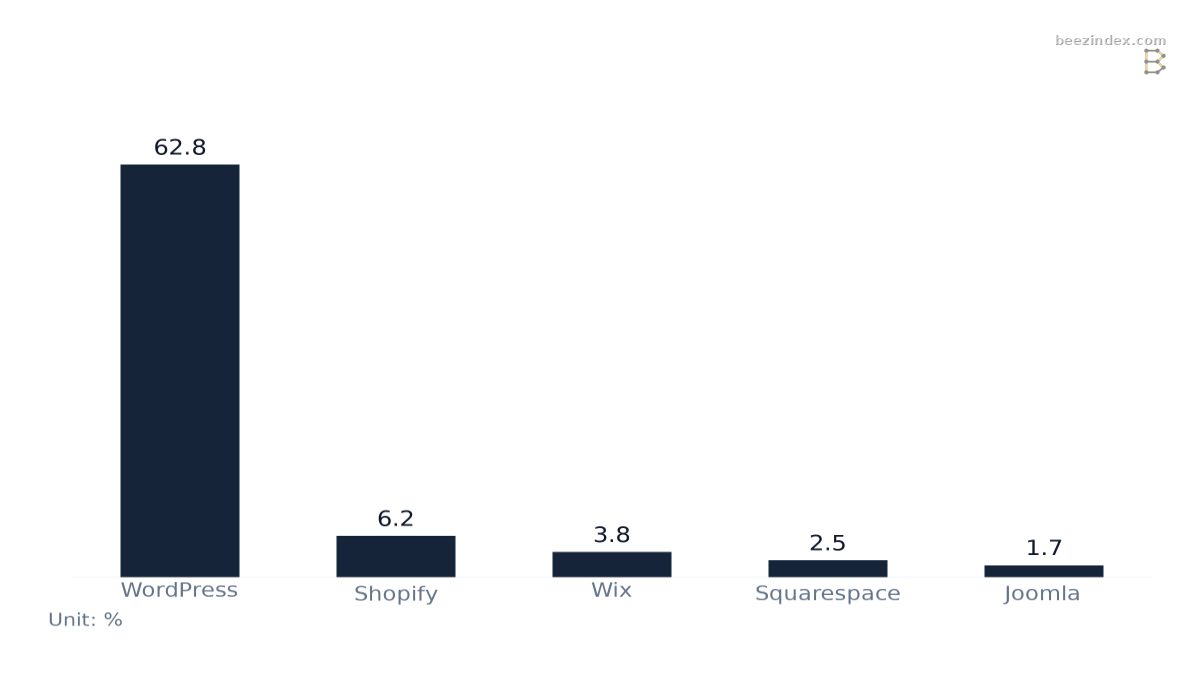
Content management system distributions show dramatic concentration across British corporate websites and digital storefronts. Market telemetry confirms WordPress holds a 62.8% CMS market share, significantly outpacing Shopify at 6.2% and Wix at 3.8%. Evaluating b2b data platforms reveals that this market dominance creates an exceptionally deep pool of prospective accounts for UK agencies.[1]
Enterprise development agencies prefer custom architectures over standard page builders when building mission-critical installations. Basic UK agency builds cost between £3,000 and £10,000, while enterprise-grade deployments regularly command budgets starting at £50,000.[2] Commercial organizations select open-source frameworks because custom deployments avoid restrictive monthly subscription tiers and support complex third-party software integrations.
UK CMS Platform Market Share
Filtering WordPress Businesses by UK Location and Industry
Refining your search by location and industry ensures that your outreach remains relevant to the specific operational needs of your prospects.
Geographic clustering dictates service delivery, regional sales alignment, and in-person agency consultation opportunities across the British Isles. London serves as the primary operational base for digital threat intelligence firms running the platform, representing 38.9% of that entire national cohort. Teams use a cleaner approach to sourcing to isolate regional commercial clusters and build relevant localized proposals.
Vertical segmentation reveals sharp contrasts in platform adoption across domestic industries. Industry telemetry shows WordPress powers 78.7% of detectable content management systems across the United Kingdom CCTV and commercial physical security sector. Specialized service agencies exploit these vertical concentrations to craft sector-specific packages addressing common technical challenges and industry compliance requirements.
Compliance demands vary across commercial sectors, making industry filtering a vital qualification step. Organizations operating under the Data Use and Access Act 2025 must fulfill customer data requests within 30 days.[1] Failing to isolate regulated industries before outreach risks pitching non-compliant hosting solutions or generic plugins to enterprises requiring strict statutory handling.
Putting WordPress Intelligence to Work for Your Team
Revenue teams convert technographic intelligence into commercial agreements by targeting observable infrastructure deficits and maintenance vulnerabilities. Security research confirms that 91% of content management system vulnerabilities originate directly within third-party plugins. Service providers audit prospect lists for abandoned add-ons, sluggish mobile page speeds, and missing security headers to structure compelling value propositions.[1]
BeezIndex simplifies this prospecting workflow by unifying technical footprint analysis with active corporate records and hiring registries across Britain. Sales analysts start with a free search to explore baseline company data and examine basic technology detections. Organizations then upgrade their plan to access advanced monitoring features and shared intelligence tools to track new deployments, staff departures, and infrastructure overhauls.
Using Hiring Signals to Spot Active WordPress Projects
Beyond static infrastructure, real-time hiring data provides a window into a company's immediate technical priorities.
Job advertisements for front-end developers, full-stack engineers, and digital marketing leads represent meaningful changes within client organizations. Corporate careers boards and applicant tracking systems expose commercial plans long before public project launches. Revenue teams assess potential client fit by monitoring open vacancies for specific mentions of custom themes, plugin architecture, or WooCommerce maintenance.
Stale postings older than 45 days reflect unfulfilled searches or internal operational delays, so researchers focus strictly on fresh vacancies. Combining active recruitment records with verifiable software detection identifies accounts with allocated project budgets and pressing delivery deadlines. Outreach teams convert leads at higher rates because their technical support proposals directly address the workload bottlenecks that motivated the original job listing.
Summary of WordPress Prospecting Insights
Modern business development requires shifting away from generic industry codes toward verifiable digital infrastructure and observable web signals. Market audits verify 98,435 active UK companies using WordPress across publishing, business services, and ecommerce sectors. Technical sellers isolate high-probability opportunities by combining underlying CMS signals with geographic territory filters, specific vertical categories, and live recruitment requisitions.
Establish an ongoing prospect monitoring pipeline that pairs fresh technographic evidence with applicant tracking signals and public corporate records. Audit candidate shortlists for recent crawl dates and require multi-point script verification before launching bespoke sales sequences. Start researching qualified domestic accounts using verified web intelligence to build reliable pipeline momentum across your commercial territory.
Frequently Asked Questions
How accurate is automated WordPress detection on UK websites?
Modern scanners achieve accuracy rates exceeding 95% when sites expose standard asset paths, plugin directories, and REST API endpoints. Obfuscated installations require secondary footprint analysis such as login path checks and database query signature detection.
Can I filter UK WordPress companies by county or postal region?
Yes, pairing technographic detections with official Companies House corporate records isolates businesses by registered office address or commercial trading postal code. This geographic segmentation enables precise regional sales territory distribution across England, Scotland, Wales, and Northern Ireland.
What defines a high-confidence WordPress detection score?
A high-confidence score reaches 80% to 100% when a scanner verifies multiple distinct signals including core asset paths, theme headers, and active plugin calls. Single-signal detections receive lower scores because shared caching layers or reverse proxies can produce false positive results.
How do active hiring signals help qualify WordPress prospects?
Active developer job listings confirm that an organization possesses dedicated operating budgets and immediate digital requirements. Vacancies posted within the past 45 days highlight active modernization projects, platform expansions, or internal team skill shortages.
What compliance rules govern cold outreach to UK WordPress companies?
Outreach must establish a defensible lawful basis under UK GDPR and strictly satisfy Privacy and Electronic Communications Regulations. B2B corporate communications must provide clear identification, verified sender details, and immediate opt-out mechanisms.
Why target WordPress websites instead of proprietary hosted platforms?
Open-source installations require external agency support, dedicated hosting management, regular security updates, and custom plugin development. In contrast, proprietary platforms like Wix or Squarespace bundle hosting and maintenance into closed subscriptions that offer limited agency opportunity.
Start a free search to explore verified company data, then upgrade your plan to access advanced monitoring features and shared intelligence tools.
Start Discovering UK WordPress BusinessesReferences
- Wordpress Security Gdpr Checklist
- Top Wordpress Development Companies Uk
- Companies Using WordPress in the UK: 98,435 Active Firms (2026) | Firmbase
- Threat Intelligence Companies Using WordPress in the UK: 95 Active Firms (2026) | Firmbase
- CCTV Companies Using WordPress in the UK: 1,109 Active Firms (2026) | Firmbase