
Oct 12, 2026
Read in: English (United Kingdom)
How to Find UK Companies Using Shopify
The United Kingdom hosts 231,569 live Shopify stores as of 2026. Sales teams identify high-value prospects by filtering for specific industry sectors, geographic clusters, and active hiring signals. This guide explains how to verify merchant infrastructure and build clean, actionable prospect lists to improve conversion rates for agency outreach.

Outbound sales teams lose valuable time when generic business registries lump digital retailers into broad, outdated company lists. You need direct ways to verify which brands run their stores on Shopify before spending hours on custom pitches. Modern prospecting relies on observable code markers, merchant infrastructure, and active team growth signals. A structured search strategy separates high-growth ecommerce brands from hobby shops without manual browsing. This practical framework gives you verified merchant profiles, geographic clusters, and live operational signals across the British market.
What Makes UK Companies Using Shopify a High-Value Segment
UK companies using Shopify represent an active commercial segment with measurable digital investments and ongoing technical requirements. The United Kingdom ranks as the second-largest global market for Shopify adoption after the United States.[3] Commercial agencies target these brands because platform adoption proves that the merchant manages a dedicated online checkout infrastructure.
Prospecting teams study website infrastructure to solve the limitations of automated lead generation when basic business registers fail to indicate active online trading. Observable web intelligence confirms whether a merchant accepts real payments, uses enterprise inventory apps, and maintains modern web designs effectively.
Merchants on this platform frequently evaluate payment providers, conversion rate optimization tools, and logistics partnerships. Fast-growing brands require third-party software connections and specialist agency support to maintain their market share. In contrast, unverified directory records often lead sales teams to dormant companies or dead domains, wasting up to 40% of campaign time.
Signals That Reveal a Shopify-Powered UK Business
Direct code inspection provides clear evidence when qualifying potential ecommerce accounts. Standard Shopify stores host assets on content delivery networks containing cdn.shopify.com within the source code. Public cart endpoints, Shopify payment gateways, and platform checkout scripts verify the active software layer.[1]
Beyond technical infrastructure, operational efficiency serves as a primary indicator of merchant maturity. Retailers integrate specialized software to handle customer operations, returns, and delivery management. For example, processing costs for returned online items are estimated at $10-20 per item.[2] Merchants adopt automation tools and tracking applications to reduce these operational expenses across their regional supply chains.
Verified company-to-website intelligence links observed code fingerprints to official legal entities. Marketing teams track installed review widgets, email capture forms, and analytics tags to measure technical maturity. In contrast, outdated web caches often create false positives when businesses migrate away from legacy systems.
Estimated Processing Cost per Returned Online Item

Key Takeaways
- The UK hosts over 231,000 live Shopify stores, representing the second-largest national market worldwide.
- Direct code markers like cdn.shopify.com confirm platform usage faster than static directory listings.
- Filtering by location, headcount, and hiring activity isolates high-growth merchants from inactive store websites.
- Mobile traffic delivers 68% of visits and 79% of purchases across active merchant sites.
- Combining technical stack data with official UK company records prevents wasted outbound outreach hours.
Shopify Store Conversion Benchmarks to Gauge Prospect Fit
Sales teams evaluate sales cycle efficiency by comparing merchant store performance against verified commercial industry standards. The average Shopify store conversion rate ranges from 1.4% to 1.8% across typical retail product categories. Agencies identify struggling merchants who sit below the 1.4% threshold to pitch site redesigns and conversion optimization services. Outreach campaigns achieve higher response rates when technical audits highlight observable gaps in store checkout flows or speed scores.
High-performing stores invest heavily in customer retention tools, direct email workflows, and customer service automation. Email marketing remains an exceptional acquisition channel, boasting an average conversion rate of 4.29% for top digital brands. When agency teams pitch marketing retainers to Shopify companies UK, reference points based on verified sector performance establish immediate trust. Merchants operating beneath industry benchmarks seek immediate technical remedies to protect their operating margins from rising customer acquisition costs.
Shopify Store Conversion Rate Range

How Mobile Shopping Shapes Shopify Store Performance
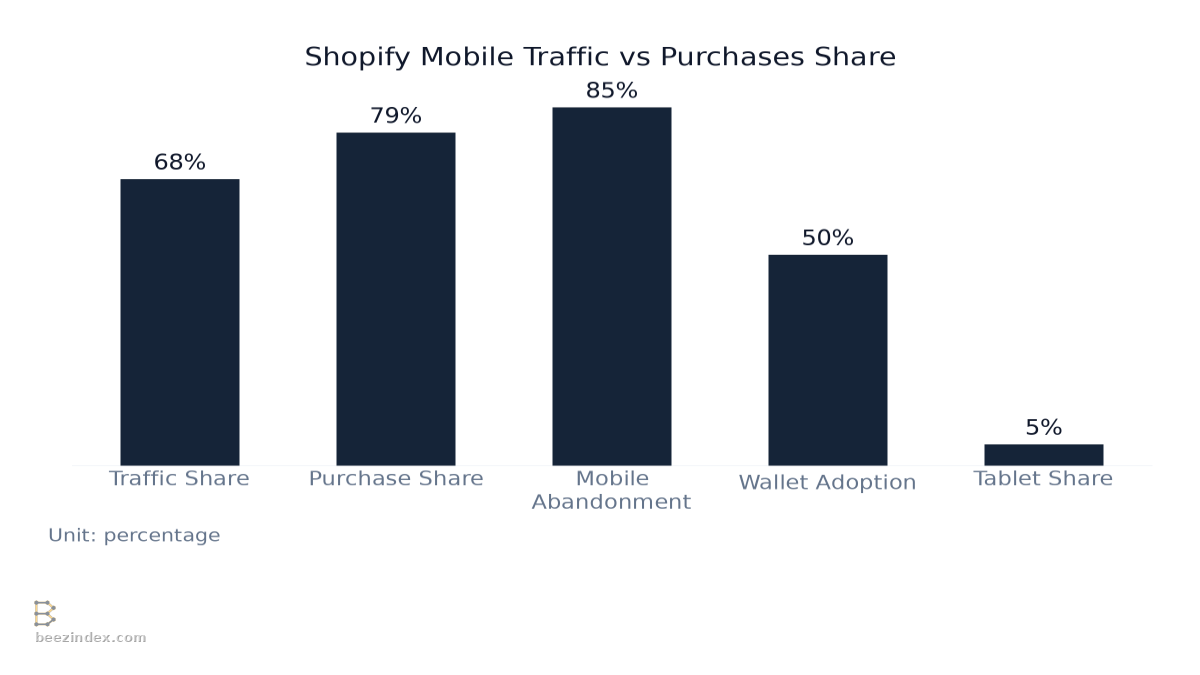
Prospecting teams conduct thorough due diligence on mobile responsiveness before qualifying British ecommerce leads for service campaigns. Mobile devices account for 68% of traffic and 79% of purchases on the Shopify platform. Merchants with slow mobile load speeds lose qualified buyers because mobile cart abandonment reaches 85.65%.[2] Technical audits focused on mobile layout stability allow agencies to open sales conversations with measurable evidence rather than generic sales copy.
Checkout friction directly damages revenue when stores fail to offer accelerated mobile payment methods. Digital wallets such as Apple Pay and Shop Pay boost conversion rates by up to 50% compared to traditional guest checkouts. Agencies review mobile page elements, script bloat, and payment options to spot brands requiring urgent theme modernization. High-growth UK retailers prioritize mobile-first interfaces because smartphone checkouts generate the majority of total consumer orders.
Shopify Mobile Traffic vs Purchases Share
Narrowing Shopify UK Results by Industry, Location and Hiring Activity
Prospecting databases must filter millions of web domains to find genuine commercial opportunities. Filtering by industry category allows business development teams to target sectors with high transaction volumes. For example, the apparel sector accounts for 25.1% of all Shopify stores in the UK.[1] Targeting specific sectors ensures that service providers tailor case studies directly to relevant product categories.
Geographic filtering isolates active distribution centers and trading headquarters across British regions. Linking domain evidence with Companies House records confirms company incorporation dates, registered office addresses, and official director details. Enterprise sellers look for established trading track records to avoid sole traders operating micro-businesses from residential addresses.
Immediate hiring signals provide strong indicators of commercial expansion and available software budgets. Companies posting open vacancies for ecommerce managers, performance marketers, or inventory coordinators show immediate investment intent. Technographic platforms track careers pages and applicant tracking systems to capture these hiring signals before competitors notice them.
For instance, a software agency might filter for apparel retailers in the West Midlands that are actively hiring for a 'Shopify Developer' role. This specific combination signals a merchant with both a clear technical need and an allocated budget for platform improvements, allowing the agency to bypass generic cold outreach in favor of a tailored proposal.
Prospect Filtering Criteria and Outcomes
| Filter Type | Observed Signal | Strategic Value | Primary Use Case |
|---|---|---|---|
| Technology Stack | Shopify Plus Scripts | Confirms enterprise budget | High-value sales prospecting |
| Sector Category | Apparel and Fashion | Represents 25.1% of stores | Targeted marketing campaigns |
| Hiring Signals | ATS job postings | Shows active team growth | Recruitment and agency outreach |
| Shipping Carriers | Royal Mail integration | Confirms UK domestic operations | Supply chain consulting |
| Payment Systems | Shop Pay and Klarna | Indicates conversion focus | Fintech merchant acquisition |
| Domain Extension | .co.uk and .com | Isolates UK domestic sellers | Regional market research |
Where Shopify Adoption Clusters Across the UK
Sales teams build targeted prospecting lists by mapping regional adoption trends across British industrial and commercial centers. England hosts the vast majority of online merchants, with London serving as the primary hub for fast-growing lifestyle brands.[1] Regional retail clusters also operate extensively across Greater Manchester, the West Midlands, and Yorkshire. Identifying regional hubs helps field sales representatives plan local events, in-person meetings, and regional partner campaigns.
High-volume merchants maintain distinct operational setups compared to entry-level shops. In the UK market, Shopify Plus powers 6,350 enterprise stores that manage complex supply chains and large product catalogs.[1] In addition, Shopify holds a 23% market share across the UK ecommerce software industry. Business development managers target these enterprise accounts because high-volume merchants possess the budget for bespoke software integrations, custom headless frontends, and enterprise logistics networks.
Turning Shopify UK Data Into Sales, Agency and Research Outcomes
Agencies, software vendors, and market analysts apply technographic intelligence to streamline commercial outreach. Sales teams prioritize accounts using connected marketing tools like Klaviyo to identify merchants that actively spend on digital acquisition. Market researchers track software adoption trends across retail categories to benchmark market share shifts. Rather than relying on generic registries, teams start with a free search at BeezIndex to explore company data, then upgrade to unlock advanced monitoring and shared intelligence tools.
Account executives export filtered company lists into customer relationship management platforms to maintain clean outbound workflows. Technographic discovery tools like BuiltWith and BeezIndex identify installed checkout apps, hosting setups, and live payment gateways. Outreach teams craft specific pitches around verified operational needs, such as international currency support or automated fulfillment systems. Grounding sales conversations in verified technical facts drives higher conversion rates across competitive agency markets.
Verifying Shopify UK Company Data Before You Use It
Research teams search for uk firms by testing domain records against regulatory filings before launching direct outbound sequences. Technographic crawlers analyze public website code, but legacy scripts or staging servers can create false positives. Analysts verify domain ownership by checking Companies House data, corporate registration numbers, and public contact information. Clean lists prevent outbound domain blocks and protect sender reputation across cold communication channels.
Outreach specialists adhere to UK GDPR regulations and PECR standards when contacting commercial decision-makers. Corporate email outreach remains lawful under the legitimate interest basis when communications provide a transparent opt-out mechanism. Furthermore, 67% of UK Shopify stores provide an email address directly on their public web pages.[1] Validating corporate contact details against freshness indicators ensures that commercial teams connect with active decision-makers without wasting outreach budgets.
What to Remember
The United Kingdom contains 231,569 live Shopify stores, creating an expansive market for digital agencies and technology providers. Successful business development requires separating enterprise accounts and growing brands from inactive side projects. Modern prospecting teams use observable code signals, payment provider footprints, and Companies House records to assemble verified prospect databases.
Filter your target merchant lists by industry sector, regional location, and live recruitment signals to identify businesses with urgent operational needs. Review store benchmarks such as mobile performance and conversion rates to create relevant, evidence-led sales messages. Begin your prospect research by auditing live website code markers to build a clean pipeline of qualified commercial opportunities.
Frequently Asked Questions
How do you confirm a UK website runs on Shopify?
You can inspect the public page source code for links pointing to cdn.shopify.com or references to the Shopify object. Many stores also expose checkout workflows under standard myshopify.com paths or distinctive platform endpoints. Technographic databases automate this detection process across millions of live domains simultaneously.
How many Shopify stores operate in the United Kingdom?
There are 231,569 live Shopify stores in the United Kingdom as of October 2026. The platform experienced an 11% year-over-year increase in the UK market during recent fiscal quarters. High-volume enterprise merchants run 6,350 of these stores using Shopify Plus.
How often should teams refresh their Shopify business database?
Teams should refresh their prospective lists every 30 to 45 days to capture new store launches and migrations. Job postings and hiring signals older than 45 days often become stale as companies fill open roles. Regular data cleansing prevents sales teams from contacting businesses that have altered their technology stack.
Does active hiring activity signal buying intent for software?
Yes, stores posting job openings for ecommerce coordinators or performance marketers demonstrate operational growth. These companies actively invest capital to expand their operational capacity and digital marketing reach. Reaching out during an active hiring phase aligns your pitch with expanding company budgets.
Is B2B cold emailing compliant with UK GDPR for online stores?
Direct marketing to corporate email addresses is permitted under UK GDPR and PECR rules under legitimate interest. You must ensure that your outreach is strictly relevant to the recipient's commercial responsibilities. Every outbound message must provide an accessible, unambiguous opt-out mechanism.
How can you export Shopify store data into your CRM?
Most technographic prospecting platforms provide direct CSV export capabilities or automated REST API connections. You can map custom attributes such as web technologies, location, and verified email contacts into your CRM. Integrating enriched records into HubSpot or Salesforce maintains automated follow-up workflows.
Start with a free search to explore verified UK company data, then upgrade your plan to unlock real-time store monitoring and shared research tools.
Discover High-Growth UK Shopify Stores Today