
Sep 28, 2026
22% of UK Firms With No Website in Your Prospect List
Official government data shows 22% of UK firms operate without a website. Sales teams often waste time by discarding these prospects. You can identify active trading entities by checking Companies House filings, balance sheets, and recent confirmation statements to maintain full market coverage and avoid calling dissolved businesses.

Sales teams discard thousands of British businesses every week simply because automated scraping tools return blank URL fields. You lose viable commercial opportunities when your pipeline rules assume every real trading enterprise maintains a digital homepage. Official state registers confirm that millions of pounds flow through companies operating entirely through traditional relationships and direct trade. We audited outbound databases to uncover why standard enrichment tools drop active commercial entities before reps make contact. The following operational benchmarks reveal exactly how to separate trading firms from dormant corporate shells.
Measuring Website Presence Gaps Across Sectors
Official government statistics reveal that 78% of UK businesses maintain an active website, which leaves 22% operating completely offline.[1] Sales teams that rely strictly on automated domain scrapers drop thousands of solvent trading enterprises from their outbound campaigns every single month. Many revenue teams make tracking uk business performance harder because they automatically delete registered corporate entities whenever an automated script fails to find a live URL.
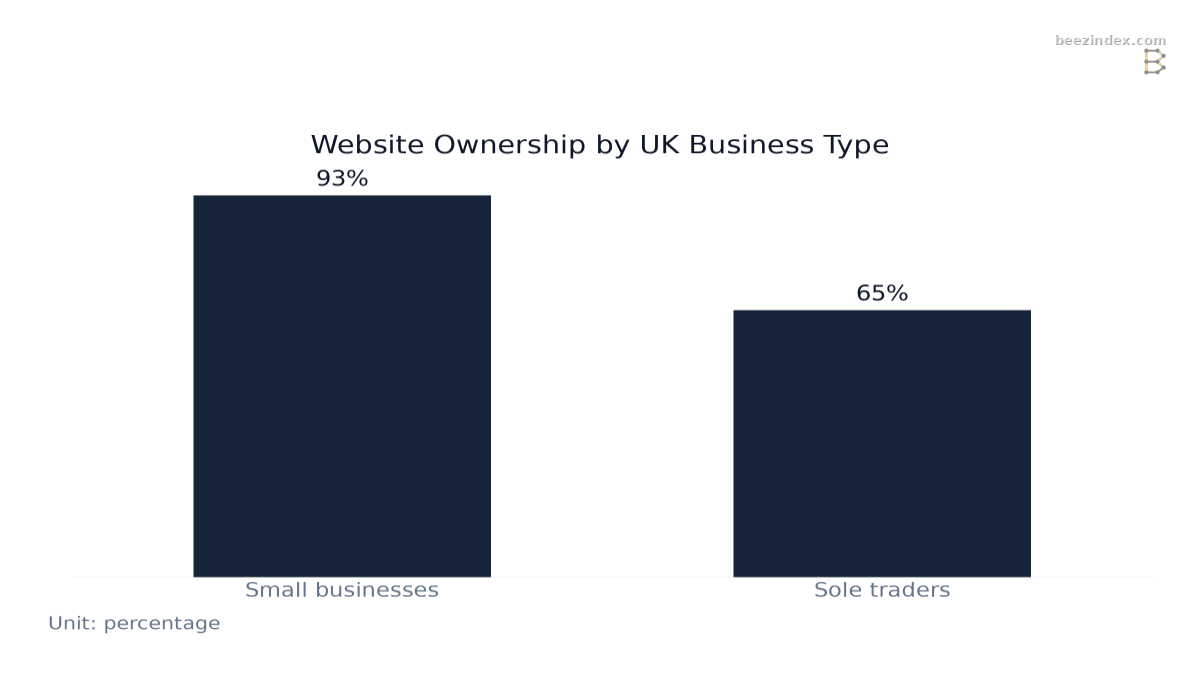
Corporate adoption metrics explain this structural divide across different trading categories within the British commercial landscape. Data indicates that 93% of small businesses maintain a website, whereas only 65% of sole traders do. Business development representatives often squander valuable calling hours targeting sole traders without prior verification, as unlisted operators rarely maintain dedicated procurement desks or public contact numbers.
Website Ownership by UK Business Type
Cross-Referencing Companies House Registry Data
Companies House provides an immutable legal baseline for evaluating UK firms without websites across every postal code. Commercial researchers review accounts filing histories, mortgage charges, and confirmation statements to establish whether an unlisted entity trades actively. Outdated marketing databases often label closed companies as viable prospects, while official registry filings instantly expose formal insolvencies and overdue compliance notices.
Statutory filings also detail the operational scale of offline enterprises by displaying balance sheets, employee headcounts, and registered capital. Officers must submit confirmation statements annually, providing data analysts with fresh timestamps on corporate activity regardless of whether the firm owns a domain name. Ignoring these official filing dates results in reps wasting up to 30% of their dialling hours chasing dissolved entities.
Offline-Only UK Firms in Traditional Trades
Traditional trades, civil engineering, regional agriculture, and precision manufacturing account for the largest proportion of offline-only UK firms. These enterprises secure commercial contracts through local frameworks, commercial tenders, and established vendor relationships rather than digital search visibility. Sales teams face misleading industry classification standards when they use broad sector tags to predict whether an industrial enterprise maintains an online footprint.
Field research demonstrates that business-to-business suppliers frequently bypass internet marketing because specialized industrial clients rely on approved supplier lists and direct purchase orders. Many mechanical engineering plants with 20 staff generate steady five-figure margins without maintaining a live homepage. Inbound marketing models fail completely in these traditional spaces, necessitating that business development reps deploy phone and direct mail workflows instead.
Direct Outreach for Offline Commercial Leads
Because digital signals are absent, sales teams must pivot to alternative verification methods to maintain prospect list coverage. Direct outreach strategies bridge the information gap when prospecting firms that lack public digital assets. Sales development representatives contact company directors using postal addresses and registered corporate phone lines to introduce services while verifying corporate existence through statutory databases.
Postal campaigns generate dependable engagement because physical letters bypass congested digital inboxes. Field teams combine geographic cluster mapping with verified physical premises audits to prevent wasted travel time and target legitimate commercial facilities.
Modern researchers use BeezIndex to check observable web intelligence before launching costly outbound campaigns. The platform matches registry entries against digital signals to maintain prospect list coverage for unlisted entities.
Filter Criteria for High-Value Offline Accounts
Filtering offline accounts requires revenue teams to evaluate firmographic metrics such as balance sheet assets, operating age, and registered employee bands. Newer companies founded within the last six months frequently trade without a domain name while preparing operational infrastructure. Commercial agencies must locate businesses currently hiring through statutory filing changes and regional apprentice boards rather than relying on online career portals.
Revenue teams verify corporate legitimacy by checking whether unlisted enterprises maintain active corporate bank accounts, registered land charges, and legal commercial debentures. Enterprises operating for more than five years without an active website often demonstrate strong recurring revenue within localized trade networks. Prospecting campaigns that apply these balance sheet filters preserve pipeline velocity while eliminating dormant or underfunded shell companies.
Connecting Identity to Verified Web Footprints
Business intelligence platforms connect statutory records with fragmented public records across trade bodies, council tender awards, and industry supplier directories. Unlisted firms frequently maintain registered directory profiles and industrial accreditations even when they lack a dedicated company website. These operational breadcrumbs confirm that an enterprise trades actively.
Automated data systems connect registered company numbers directly to regional trade accreditations and commercial vehicle registrations, protecting sales teams from purchasing obsolete contact directories. This verification provides business development representatives with high confidence before conducting phone outreach.
Account executives uncover high-value regional accounts that competitor software tools overlook completely when enrichment workflows include verified offline profiles alongside traditional digital accounts. Verified registries ensure reps spend their hours contacting genuine decision-makers rather than disconnected lines.
Data Hygiene and Pruning Dissolved Entities
Data hygiene protocols protect sales operations from wasting outreach budgets on corporate entities that ceased trading years ago. Generic business directories suffer massive decay rates because commercial closures outnumber formal company insolvencies by more than ten to one. Revenue analysts who cross-reference contract awards identify solvent enterprises that win public tenders despite maintaining no customer-facing web presence.[2]
Data hygiene teams remove dead registrations by monitoring Gazette striking-off notices, liquidation petitions, and Companies House status flags every quarter. Outbound reps waste roughly 25 minutes per day dialling disconnected switchboards when databases retain dissolved or dormant corporate records. Rigorous data cleansing routines maintain high conversion rates and ensure compliance with UK data protection regulations.
Balanced Strategies for Maximum Prospect Coverage
A balanced prospecting strategy combines statutory company registries with modern digital intelligence layers to capture the full commercial market. Data teams that focus exclusively on online businesses abandon nearly a quarter of domestic commercial enterprises.[1] Integrating registry validation protects sales pipelines from artificial website presence gaps.
Compliance officers enforce strict checks under the UK General Data Protection Regulation and Privacy and Electronic Communications Regulations. Outreach teams screen all outbound telephone numbers against the Corporate Telephone Preference Service before launching cold phone campaigns. Legitimate interest assessments provide the necessary legal foundation for contacting commercial subscribers through direct corporate channels.
Marketing departments achieve resilient pipeline growth when their outbound processes treat offline firms with the same operational discipline as software companies. Field sales reps use verified corporate addresses to deliver targeted direct mail and schedule introductory calls. This balanced coverage model captures lucrative accounts that digital-only competitors fail to detect.
Actionable Steps for Prospecting Offline Firms
Unlisted corporate entities represent 22% of the total commercial landscape across the United Kingdom. Sales organizations that immediately discard records lacking a live website forfeit access to thousands of solvent, revenue-generating commercial accounts every year. Registry checks against official filings establish trading status, financial health, and ownership details without needing public web pages.
Revenue operations leaders should audit current contact records to separate dissolved businesses from legitimate offline enterprises today. Screen unlisted telephone numbers against the Corporate Telephone Preference Service before assigning accounts to outbound representatives. Combining statutory filings with verified physical data ensures maximum prospect list coverage across every relevant British industrial sector.
Frequently Asked Questions
Why do 22% of UK businesses operate without a website?
Many traditional enterprises rely entirely on established local supplier frameworks, repeat trade relationships, or direct tendering rather than digital customer acquisition. Small trade contractors and regional agricultural suppliers often generate stable revenue without ever needing an online commercial presence.
How do you verify if a no-website firm is still active?
Cross-reference the company number on Companies House to review recent confirmation statements and annual accounts filings. Entities that filed statutory accounts within the previous nine months are legally active and trading.
What privacy regulations apply when calling offline UK businesses?
Outbound teams must comply with the Privacy and Electronic Communications Regulations and UK GDPR standards. Sales reps must screen corporate phone numbers against the Corporate Telephone Preference Service register before calling.
Can you send direct postal mail to offline company directors?
Direct postal marketing does not fall under the strict electronic consent mandates of PECR. Commercial teams can send addressed letters to registered business premises under legitimate interest provisions of UK GDPR.
How do offline prospects impact outbound sales conversion rates?
Unverified offline records lower conversion rates if sales lists contain dissolved entities or dormant holding companies. However, verified offline trading firms often yield higher deal values because fewer digital-first competitors target them.
Start with a free search to explore company data and identify active trading entities across the United Kingdom.
Verify UK Companies With Observable Web Signals