
Nov 11, 2026
AIMA Data Shows Integration Is the Real Barrier for UK Company Datasets
AIMA research shows 71% of hedge fund managers struggle with alternative data integration. This article outlines how UK analysts can map public website signals to Companies House records. It provides a practical checklist for testing dataset quality and entity resolution before signing vendor contracts to avoid common analytical bottlenecks.

Investment analysts frequently hit severe obstacles when merging external corporate intelligence into existing portfolio models. The Alternative Investment Management Association reported that 71% of surveyed hedge fund managers view combining disparate feeds as their single hardest analytical hurdle. Alternative data integration requires robust operational plumbing rather than simply collecting more raw files. You need dependable public website signals that map reliably to legal corporate records without corrupting existing database tables. High confidence evidence clarifies actual company health, so let us examine the numbers shaping current research workflows.
UK Company Datasets and Integration Challenges
Alternative data integration presents major operational obstacles for research teams because raw web feeds rarely match official registry schemas directly. AIMA survey findings confirm that 71% of fund managers view blending disconnected feeds as their main operational barrier. When data engineers spend weeks formatting untyped text, team productivity crashes, hindering the ability to understand your market.
Corporate research requires careful evaluation of company registries alongside external digital footprints. Many analysts focus on scaling business data integration processes, but mismatched identifiers cause serious duplicate records and broken relational joins. For example, Companies House records do not track commercial web domains, so analysts must build custom matching logic to connect official accounts with digital storefronts.
Mechanics of Public Website Signals
Public website signals capture visible digital infrastructure directly from online business properties. Automated systems record ecommerce tools, analytics tags, and web frameworks across corporate homepages. While frontend scripts remain visible, backend enterprise software stays hidden without public endpoints, requiring analysts to rely on what is connected to what is observable online.
Teams collect verified company-to-website intelligence by linking domain metadata to registered legal names. Researchers extract technographic signals by inspecting client-side libraries, embedded payment gateways, and active script paths. When automated crawlers observe software footprints, analysts log the detected vendor names alongside clear timestamps.
Analysts must distinguish between frontend styling frameworks and true core enterprise installations. For example, a tracking tag proves marketing experimentation, but it cannot prove enterprise resource planning adoption. Careful analysts classify web observations as corroborating indicators rather than absolute statements of contractual spend.
Corporate Governance and AI Policy Adoption
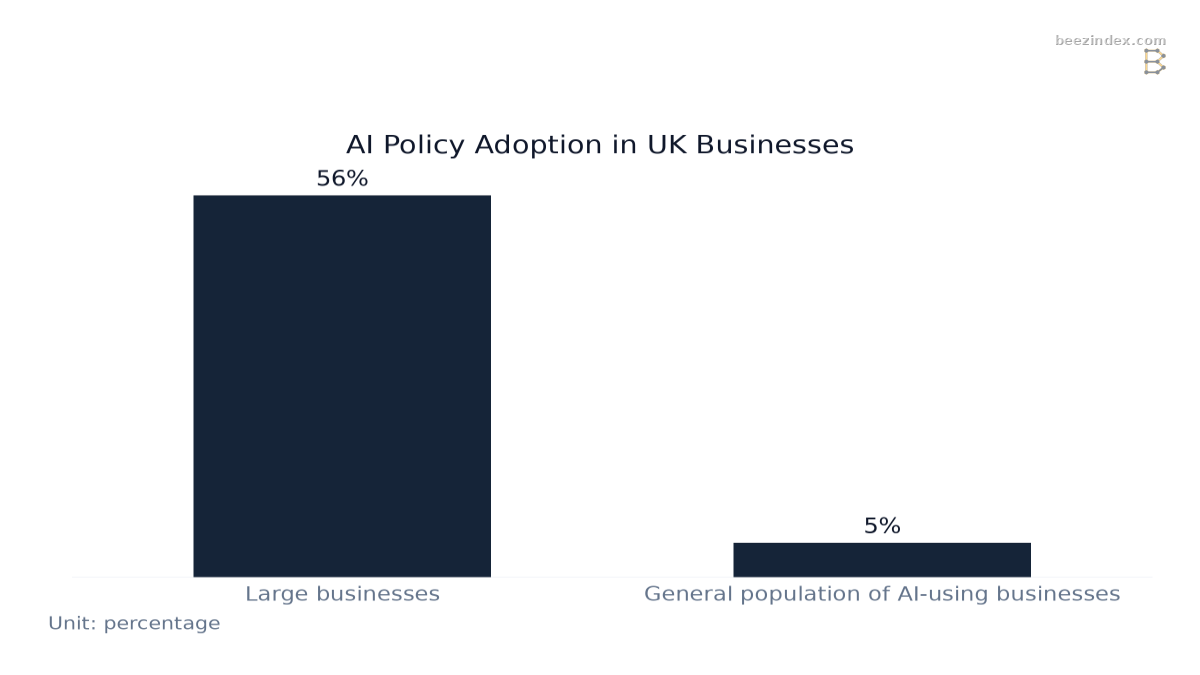
Investment research into digital maturity requires rigorous due diligence because corporate governance standards vary dramatically between large enterprises and smaller market participants. Sourced research from the Department for Science, Innovation and Technology shows a clear operational divide. Specifically, large businesses are significantly more likely to have formal written AI policies (56%) compared to the general population of AI-using businesses (5%).[2]
Analysts studying operational spend must look beyond simple web tools when examining digital maturity. Teams risk drawing flawed conclusions when evaluating site speed data without checking internal governance documentation or technical hiring trends. In contrast, evaluating verified policy disclosures and structured operational records prevents researchers from misjudging corporate technology investments.
AI Policy Adoption in UK Businesses
Matching Company Numbers to Domains
Beyond identifying software footprints, analysts must ensure that these signals are correctly mapped to legal entities. Connecting Companies House numbers to web domains requires a multi-step entity resolution process. Analysts extract legal corporate names from site footers, terms of service, and privacy policies, as missing company numbers create broken links across corporate databases.
Entity resolution systems apply fuzzy string matching algorithms to bridge discrepancies in commercial trading names. Automated pipelines flag conflicting address signals between Companies House filings and digital contact pages. High error rates emerge when shared hosting platforms host multiple unrelated businesses.
Building a reliable business-level intelligence layer demands strict confidence scoring for every proposed match. For example, an exact company number found on a checkout page yields higher confidence than an unverified name match. Solid matching pipelines discard ambiguous domain pairs to prevent bad data from polluting downstream financial models.
Evaluating Alternative Dataset Quality
Data preparation demands transparent evidence and freshness indicators because investment analysts cannot risk feeding stale inputs into quantitative models. AIMA research notes that 53% of hedge fund managers currently use alternative datasets in their investment workflows.[1] Without clear audit trails, quantitative models fail back-testing checks, and 77% of market-leading managers report serious challenges in back-testing historical data feeds.
Regional analysis reveals distinct operational variances across regional ecommerce platform trends that analysts must account for during initial pipeline configuration. For example, regional merchants often maintain legacy billing platforms that emit obsolete tracking scripts for years after migration. Reliable datasets provide historical snapshots and explicit confidence flags, allowing researchers to filter out ghost signals before running portfolio screens.
Testing Integration Before Buying Datasets
Prudent research teams test alternative data feeds across representative sample cohorts before signing multi-year vendor contracts. Effective evaluation requires verifying primary key stability, refresh frequencies, and the presence of explicit schema definitions across all records.
Thorough vendor audits must measure identifier coverage against official UK company registries. Analysts run automated match rate tests across a sample of 1,000 entities to calculate true resolution percentages. Low match rates force expensive manual data preparation that erodes the commercial value of the underlying purchase.
BeezIndex offers a searchable index of 4.5 million domains matching UK companies with clear evidence trails. Researchers can start with a free search to explore company data and upgrade to access advanced monitoring tools. Testing actual data points beforehand protects investment teams from investing capital into incompatible third-party feeds.
Legal Compliance for Web Intelligence
Investment research teams must manage data protection laws when ingesting external digital intelligence from public company websites. Article 5 of the UK General Data Protection Regulation demands purpose limitation and fair data processing for all corporate investigations. Scraping public pages does not grant unlimited marketing or processing consent under UK law, so compliance teams must establish a clear lawful basis.
Compliance officers examine data pipelines to verify that automated systems collect company-level operational indicators rather than unprotected individual personal records. Analysts who evaluate firms through web metrics avoid compliance breaches by focusing on public business software choices and corporate structures. In contrast, teams that ignore PECR and UK GDPR risk heavy regulatory sanctions from the Information Commissioner's Office.
Managing Quantitative and Fundamental Workflows
Hedge funds spend roughly 0.1% of assets under management on alternative data acquisitions according to AIMA benchmark studies.[1] Industry leaders adopt a quantamental strategy that blends traditional balance sheet analysis with real-time web telemetry. When teams merge disparate sources effectively, they generate actionable investment theses, but poorly integrated pipelines create operational bottlenecks that impede investment research.
Management teams must allocate appropriate resources to internal data engineering rather than relying solely on third-party aggregators. Only 15% of hedge fund firms employ a dedicated Chief Data Officer to oversee alternative data integration.[1] As a result, investment analysts take on data transformation burdens, diverting their time from core financial modeling and alpha discovery.
What to Remember
Combining disparate external feeds remains the primary analytical hurdle for 71% of hedge fund managers using alternative data streams. High confidence investment decisions require verifiable company-to-website linkages rather than unverified commercial aggregations. Merging Companies House filings with observable web intelligence provides clear operational context, but analysts must filter out incomplete frontend signals before running quantitative screens.
Audit vendor schemas against your existing database keys before committing investment capital to new external data feeds. Establish clear data governance frameworks and verify compliance with UK GDPR Article 5 standards across all enrichment processes. To keep research moving efficiently, run small integration pilot tests and prioritize datasets that provide transparent evidence indicators.
Frequently Asked Questions
Why is integrating UK company datasets difficult?
Official Companies House records do not maintain native web domain identifiers for UK registered entities. Analysts must build custom entity resolution logic to connect registry records to public website signals without creating duplicate entries.
What percentage of hedge funds struggle with data integration?
AIMA research confirms that 71% of surveyed hedge fund managers cite combining disparate data sources as their biggest analytical challenge. This technical friction delays investment research and increases data preparation overhead across quantitative teams.
Does public web data require UK GDPR compliance?
UK data protection laws apply whenever public web collection processes extract identifiable personal data from corporate websites. Compliance teams must establish a valid lawful basis under UK GDPR Article 5 and observe strict PECR direct marketing rules.
How much do funds typically spend on alternative data?
Surveyed hedge funds allocate approximately 0.1% of total assets under management toward purchasing external alternative datasets.[1] Costs vary widely depending on dataset uniqueness, delivery latency, and historical back-testing depth.
Run a free company search on BeezIndex to evaluate verified website signals, monitor corporate digital changes, and access advanced market intelligence.
Start Researching UK Companies Today